KICP Education & Outreach
|
Space Explorers, Inner-City K-12 Enrichment Program Space Explorers Program - Celebrating the first 25 Years We are celebrating (and documenting) the impact and success of the KICP Space Explorers Program. Since 1991, the Space Explorers Program has provided deep and meaningful experiences to over four hundred urban youth and one hundred scientists-mentors. Space Explorers has been a signature program of the KICP since its inception as a NSF Physics Frontier Center in 2001. The milestone of the 25th Anniversary is an opportunity to celebrate, document achievements and look forward to the future. Program Overview Goal: to broaden & diversify the STEM workforce - over 100 contact hours/year
- weekly in-depth on campus laboratories
- residential science institutes at Yerkes Observatory
- teaching experiences for researchers
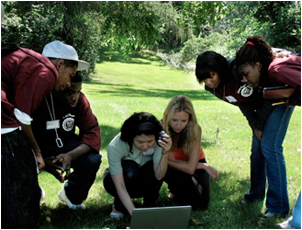
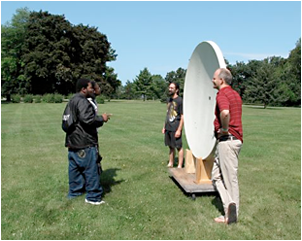
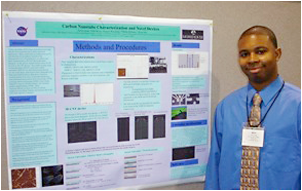
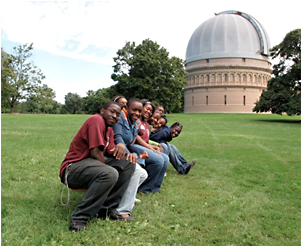
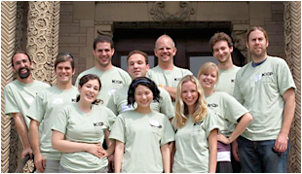
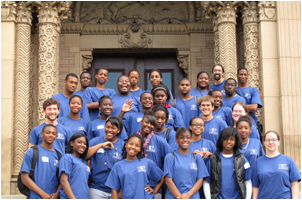
The Space Explorers Program offers inner-city youth from neighborhoods around the university a multi-year science enrichment opportunity. The program provides over one-hundred (100) contact hours each year including weekly laboratories taught on campus, three-day winter and week-long summer residential science institutes at Yerkes Observatory. This sustained engagement offers the Space Explorers the opportunity to become familiar with the university research community and the culture of science. It also helps to cultivate future teacher/scholars by offering a variety of valuable teaching, communication and team-working experiences to younger scientists. Participants are recruited by the Office of Special Programs , our partner with deep community roots, and are selected based on interest and commitment rather than grades or test scores. Each year between 20-30 Chicago Public middle and high school students participate (100% African American and typically 60% female). On average students stay in the program for three years, and the results are impressive. Program graduates succeed at a rate that is over five times better then their peers: - 100% in college
- 54% STEM majors (STEM = Science Technology, Engineering & Math)
Residential Science Institutes The Yerkes Winter Institute (YWI) December 27-29 The Yerkes Summer Institute (YSI) ~ August, 1-8. The biannual residential institutes held at Yerkes Observatory (Williams Bay, WI) provide an immersive environment that encourages scientific curiosity and exploration. The retreat like setting offers ample time for in-depth studies (e.g., 5.5 hrs/day lab) and for valuable informal interactions with center scientists. During the first half of the institute students explore thematically linked daytime laboratories and nighttime investigations (e.g. using Observatory telescopes) in small groups. During the latter part of the institute, each of three reporting groups explores a single laboratory in greater depth (e.g. over two additional days in the summer) and prepares a presentation for parents and peers that culminate the institute. Teaching Experiences Each year a graduate student elects to lead the program and gains valuable pedagogical experience designing and implementing the curriculum. This student also leads a team of volunteers who work together to develop and implement the residential science institutes at Yerkes Observatory. Over 60 Center members have taught in residence at KICP Yerkes science institutes. Many other members of KICP are involved in the program through designing laboratories for the institutes, weekly tutoring, and other enrichment activities. Yerkes Institute Archive - Demystifying everyday electronics, Yerkes Winter Institute (December 27 - 29, 2017)
- The Physics of Toys, Yerkes Summer Institute (July 30 - August 5, 2017)
- Up & Down, Yerkes Winter Institute (December 27 - 29, 2016)
- Spy vs. Spy, Yerkes Summer Institute (August 3 - 9, 2016)
- The Science of Musical Instruments, Yerkes Winter Institute (December 27 - 29, 2015)
- Mission to Mars: Engineering Design Process, Yerkes Summer Institute (August 2 - 8, 2015)
- Robotics, Telescopes and S.T.E.A.M., Yerkes Winter Institute (December 27 - 29, 2014)
- Renewable Energy: Back to the Sun, Yerkes Summer Institute (August 10 - 16, 2014)
- Transforming Energy, Yerkes Winter Institute (December 27 - 29, 2013)
- Colors Answers, Yerkes Summer Institute (August 4 - 10, 2013)
- Vision, Yerkes Winter Institute (December 27 - 29, 2012)
- Making & Breaking: Destructive Testing , Yerkes Summer Institute (August 5 - 11, 2012)
- Up!: Thrust, Buoyancy, and Drag, Yerkes Winter Institute (December 27 - 29, 2011)
- Detectors/Super Sensing, Yerkes Summer Institute (August 7 - 13, 2011)
- Surface Area, Yerkes Winter Institute (December 27 - 29, 2010)
- Simple Machines, Yerkes Summer Institute (August 7 - 13, 2010)
- Exploring the Solar System, Yerkes Winter Institute (December 27 - 29, 2009)
- The Physics of Sound, Yerkes Summer Institute (August 1 - 7, 2009)
- Cosmic Detectives, Yerkes Winter Institute (December 27 - 29, 2008)
- Energy Transformations, Yerkes Summer Institute (August 2 - 8, 2008)
- Mapping Motion, Yerkes Winter Institute (December 27 - 29, 2007)
- Mapping, Yerkes Summer Institute (August 4 - 10, 2007)
- Scale of the Universe, Yerkes Winter Institute (December 27 - 29, 2006)
- Sink or Swim? Exploring Buoyancy & Density, Yerkes Summer Institute (August 5 - 11, 2006)
- Under Pressure, Yerkes Winter Institute (December 27 - 29, 2005)
- The Nature of Light, Yerkes Summer Institute (August 6 - 12, 2005)
- Reflections, Yerkes Winter Institute (December 27 - 29, 2004)
- What are stars made of?, Yerkes Summer Institute (August 7 - 13, 2004)
- Phase Changes, Yerkes Winter Institute (December 27 - 29, 2003)
- How Big is Our Universe?, Yerkes Summer Institute (August 2 - 8, 2003)
- Scaling Up, Yerkes Winter Institute (December 27 - 29, 2002)
- Radio Waves, Yerkes Summer Institute (August 3 - 9, 2002)
- Sound Investigations, Yerkes Winter Institute (December 27 - 29, 2001)
|









 Overview